Filtering before scaling
Budget qualifiers, negative keywords and geography, so the wrong searches stop costing you money.
Search ads put you in front of demand that already exists. The work is making sure the demand you pay for is the demand you want.

Cheap clicks are easy. Cheap clients are expensive.
A campaign optimised for cost per lead will happily buy you the cheapest enquiries on the internet. We optimise against what those enquiries turn into, which is a slower number to move and the only one that pays.
Campaigns built to filter, not just to reach.
Budget qualifiers, negative keywords and geography, so the wrong searches stop costing you money.
A click that lands somewhere generic is a click you paid for and wasted. Page and ad are built as one piece.
Search, display and video follow-up across the months a homeowner spends comparing builders, paced to help rather than haunt.
Call tracking and recording, because half the enquiries this work produces never touch a form.
Click-fraud protection and routine search term review. The queries you appear for drift constantly, and left alone they drift cheap.
Form fills are not the outcome. We track through to booked and signed.

The expensive mistake here is bidding on the broad terms. A search for swimming pools attracts everyone from a child doing homework to a homeowner pricing a liner replacement. We bid where the search already implies a build and a budget, and exclude the rest deliberately.

In pool advertising, what you refuse to pay for matters more than what you bid on. Repairs, cleaning, above-ground, parts, jobs, DIY. An account without an aggressive negative list burns most of its budget before a serious buyer ever sees an ad.

Sending paid traffic to the homepage wastes it. Each campaign gets a page that answers the specific search, shows the relevant work and asks for the enquiry, which is usually where a break-even account turns profitable.
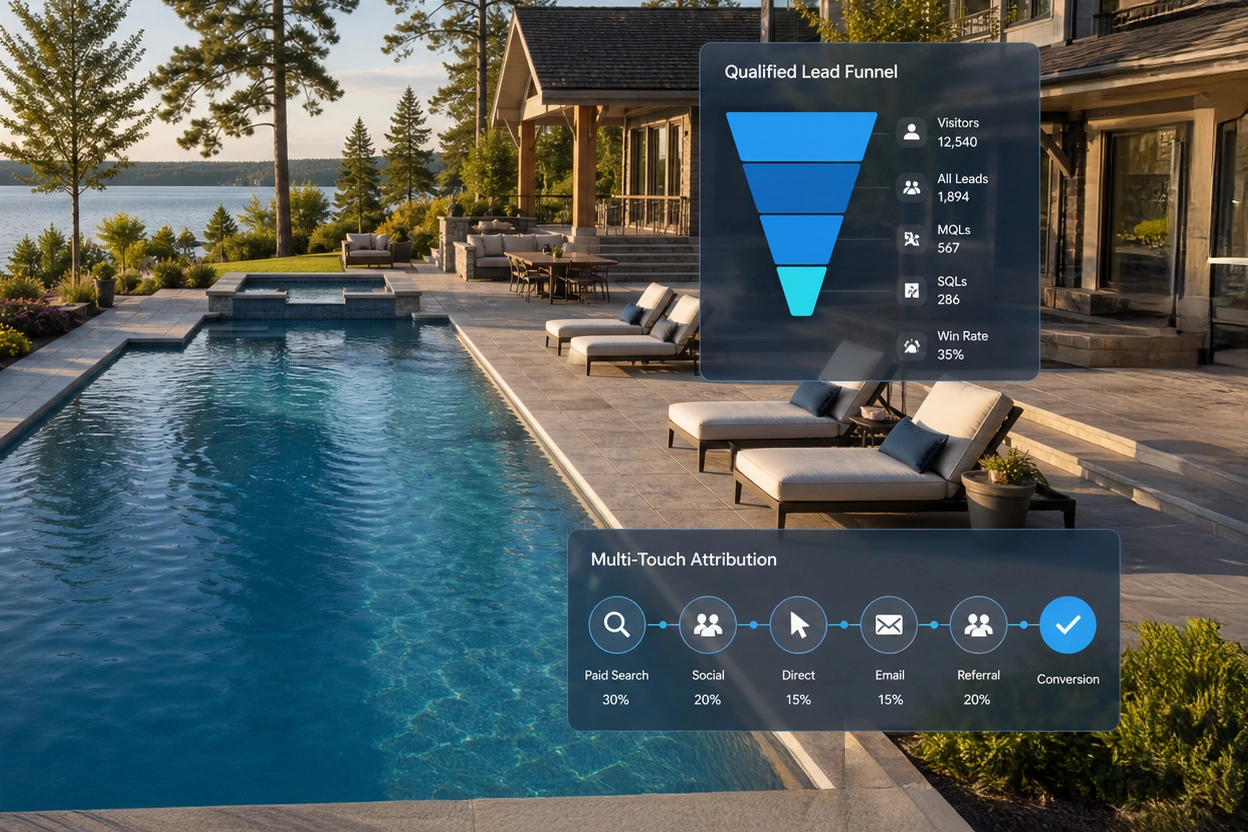
A cost per lead is easy to improve by attracting worse leads. We track through to qualified enquiries and signed work, so the account is optimised toward the projects you want rather than toward a cheaper form fill.
Before spending more, we make sure what you spend today is measured.
What you are paying for now, what it produced, what your competitors are bidding on, and what is not being tracked at all.
There is no point optimising against numbers nobody trusts.
Structure, match types and qualifiers aimed at project value.
Budget follows signed work, not clicks.
The work
Scope, materials and the decisions behind them. Buyers comparing three builders are looking for evidence of judgement, not a slideshow.

Photography and structure that carry the scale of the build, so a six-figure project does not read like a gallery entry.

What happens in the hours after an enquiry arrives, which decides more deals than any headline on the homepage.

Why a pool account is not run like every other local services account.
Demand for pools is not flat, and neither is the competition for it. Budget is shaped around the months when serious buyers search, instead of spreading evenly and being outbid exactly when it matters.
Almost nobody signs on the first click. Remarketing and the follow-up sequence are part of the setup from day one, because the enquiry that converts in March often started in November.
If the site and the follow-up are not ready, ads only make the leak more expensive. We would rather delay the spend than pour it into a funnel that loses the enquiries.
It depends on your market and your average project value, and any agency quoting a number before knowing both is guessing. What we can say is that spending below a certain floor buys data too slowly to learn from.
Sometimes. If the site loses the enquiries the ads produce, we will tell you before taking the budget rather than after spending it.
Weeks for signal, longer for confidence, and longer again for a business with a long sales cycle. High-ticket construction is not a category where a fortnight proves anything.
No long-term contracts on any of our ad work. You stay because the numbers work, not because the paperwork says you have to, and the account with all its history is yours either way.
Also part of the system
A strategy call looks at what you have now and tells you what to fix first, in what order.