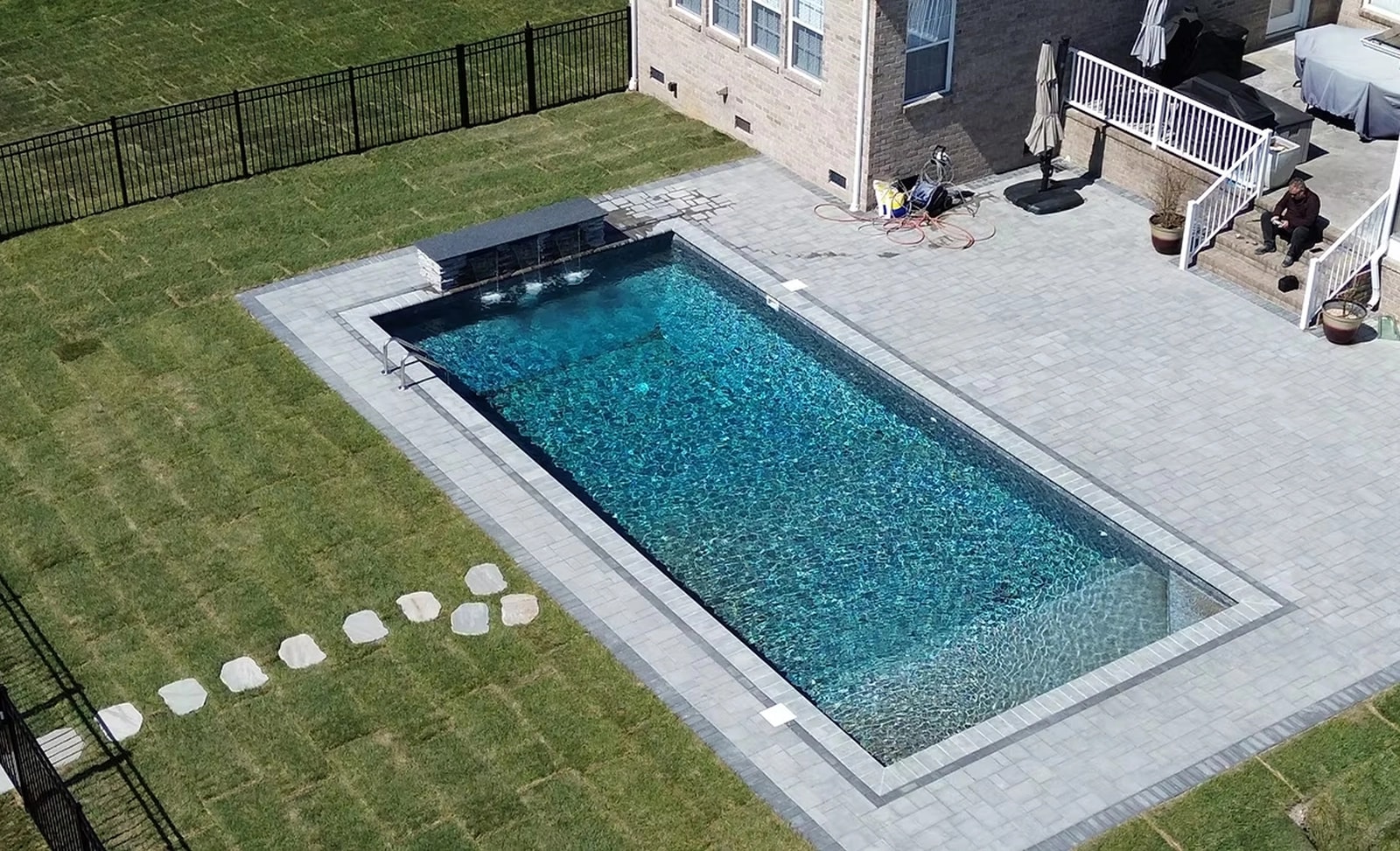
This article is part of our pool builder website design: a strategy-to-launch guide. Start with the full guide for the complete process, then use this article to work through one decision.
Use real pool project photography, thoughtful spacing and responsive mockups to make your website reflect the quality of your work.
When an affluent homeowner prepares to invest a quarter of a million dollars in a custom outdoor living environment, they are purchasing an expectation of uncompromising standards. They are buying your technical precision, your material knowledge, and your architectural vision. Every interaction they have with your business must confirm that your firm operates at this elite tier of execution.
Yet, many custom pool builders present their craftsmanship through a digital interface that suggests otherwise. They populate their websites with stock photos of smiling families in generic, blue-water pools that could belong to any suburban backyard.
Using stock assets and pre-built templates is a critical operational error. It creates an immediate gap between your physical capability and your digital presence, signaling to discerning buyers that your work is standardized. To protect your margins and command six-figure contract values, your pool builder website strategy must replace generic visuals with a custom, high-fidelity digital infrastructure.
1. Why Pre-Built Templates and Stock Photography Cheapen Your Brand
Start with a design system that supports your real portfolio and buyer journey. A template can work when adapted thoughtfully; an unedited template filled with generic copy and unrelated images is unlikely to communicate what makes your work distinctive.
Stock photography is highly transparent to the modern luxury consumer. High-net-worth buyers immediately recognize the flat lighting, unnatural staging, and generic pool designs found in public image databases. When these photos appear on your website, they suggest that you do not have a portfolio of your own to showcase, or worse, that your real builds do not meet premium aesthetic standards.
Choose layouts that can present project stories, details and proof clearly. The important question is whether the final experience supports your positioning, not whether every underlying component was created from scratch.
2. Leveraging Strategic Whitespace to Let Your Pool Photography Breathe
In luxury web design, what you leave out of the layout is just as important as what you include. Many contractor websites suffer from visual clutter, packing every pixel with text blocks, badges, icons, and small thumbnail galleries. This crowded presentation suggests a volume-based operation that is eager to prove its worth.
Elite brands use strategic whitespace, the empty space between design elements, to establish visual authority. When you surround a high-resolution image of a custom perimeter-overflow pool with ample, balanced whitespace, you force the visitor's attention onto that single build. It signals that the project is a masterpiece worthy of undivided focus.
Whitespace also improves the readability of your technical specifications. By separating your engineering case studies, hydraulic diagrams, and material descriptions with generous margins, you make the information easy to process. This spatial discipline reflects the order and cleanliness of your physical jobsites, proving to custom home builders and architects that your firm operates with structural precision.
3. Showcasing the Granular Details of Custom Stonework and Pool Finishes
Discerning homeowners who invest in estate-level outdoor environments are highly sensitive to material selections. They want to see the specific textures, colors, and cuts of the products you install. A gallery of distant, wide-angle pool photos fails to capture the true value of your masonry and finishes.
Your pool company website must showcase the granular details of your construction materials through high-resolution, close-up photography. This technical documentation should highlight:
- Bespoke Stonework: Show the precise alignment of hand-selected travertine coping, the tight joints of dry-stacked stone retaining walls, and the custom radial cuts around spas.
- Premium Finishes: Capture the light reflection on hand-tiled glass mosaics, the texture of aggregate plaster finishes, and the transition points where water meets stone.
- Custom Integration: Highlight the invisible deck drains, flush-mount lighting fixtures, and integrated pool cover lids that demonstrate your engineering standards.
Detailing these micro-elements establishes clear visual proof of your craftsmanship. It educates your prospects on the difference between standard concrete installations and custom design-build engineering, justifying your premium pricing before they ever request a quote.
4. Engineering High-Fidelity Mockups to Prove You Are Worth a Premium Tag
Before your development team writes the final code for your web presence, you must establish its visual architecture through high-fidelity custom mockups. This process is identical to creating detailed 3D renderings for a custom estate build. You would never break ground on a complex hillside pool based on a quick hand sketch; you should not build your digital presence without a precise visual blueprint.
A high-fidelity mockup allows you to customize every aspect of the user experience to match your target client profile:
- Custom Typography: Select elegant, clean typefaces that reflect architectural discipline and premium editorial design.
- Bespoke Layouts: Build unique structural frameworks that mirror the specific geometric lines and style of your physical portfolios.
- Responsive Layout Design: Ensure that every visual transition, button tap, and image scale behaves flawlessly across mobile and desktop devices.
Planning these details in the mockup stage ensures that your final digital platform acts as a seamless extension of your physical office. It shows landscape architects, general contractors, and estate owners that your firm applies the same rigorous engineering standards to your digital communication that you apply to your steel schedules and plumbing layouts.
5. Ensuring Every Visual Element Actively Justifies Your Project Minimums
If your company operates with a strict project minimum of $150,000 or more, your digital interface must act as an active gatekeeper. Every image, color selection, and interaction must support this financial boundary, filtering out price-shoppers who are looking for standard backyard packages.
If your homepage features simple, low-cost pool packages or basic plaster renovations, you will attract inquiries that match those lower tiers. Your digital real estate must focus exclusively on your highest-margin, most complex builds. If a project does not represent the scale and average contract value you want to sustain, remove it from your public portfolio.
Pair imagery with accurate explanations of the project brief, constraints and your team’s contribution. This helps buyers understand the work behind the photograph without implying that only one builder can meet their needs.
FAQs
What if we have built incredible pools, but our project photography is average?
Good photography makes craftsmanship easier to evaluate. Plan a professional shoot when practical, prioritize your most representative projects and obtain permission to publish. Clear, honest images are more useful than unsupported claims about image quality and pricing power.
How do we handle showing projects that are currently under construction?
Showing in-progress builds is an excellent way to prove your technical expertise, provided the images are presented professionally. Avoid uploading messy, uncontextualized photos from a mobile phone. Instead, create a dedicated section for construction case studies, using clean, high-contrast photos that highlight your steel reinforcement schedules, complex plumbing manifolds, or dry-stacked stone footings, explaining the engineering principles behind each phase.
Should we use 3D design renderings in our main website portfolio?
3D design renderings are valuable for showing concepts, but they should not replace real photography of finished projects in your main portfolio. High-net-worth buyers want to see completed, physical proof of your craftsmanship. Use renderings specifically on your process page to explain your design phase, but rely on real, high-resolution material photography to establish your physical credibility.
Conclusion
Commanding premium margins requires an uncompromising commitment to quality across both your physical construction sites and your digital platforms. By banishing stock assets, using strategic whitespace, and presenting the granular details of your custom engineering, you turn your website into a highly effective brand asset. This strategy-first approach ensures that your digital presence matches your operational excellence, protecting your sales capacity and positioning your firm as a credible specialist in custom pool construction.
Continue your reading
See the strategy in practice
Explore the STC Pools case study for a documented Bryant Digital project. The case study explains its own scope and reported outcomes; it is not a projection for another business.
For help applying this work, review our website design for pool builders and the Market Leader System, or explore all pool builder marketing resources.